


3D Printing in Automotive Market Forecast 2025–2035 | Technologies Compared | Automotive Applications | Regional Analysis | March 2026 | Source: MRFR 3D Printing in Automotive Market Report
| Key Takeaways
• Market valued at USD 5.948 billion in 2024 — projected to reach USD 24.99 billion by 2035. • CAGR of 13.94% — one of the highest growth rates across all automotive technology segments. • EV battery housings, lightweight structural parts, and on-demand spare parts are the three fastest-growing applications. • Metal additive manufacturing (SLM, EBM) is growing fastest within the technology stack, led by performance and EV applications. • North America leads in R&D investment; Asia-Pacific leads in volume adoption driven by China, Japan, and India. |
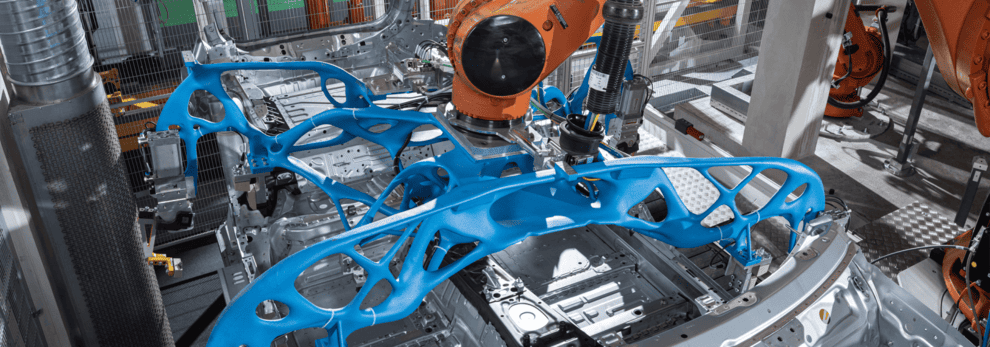
3D printing is no longer a prototyping tool in the automotive industry — it is a production technology. From EV battery housings and lightweight structural brackets to on-demand spare parts and fully customised interiors, additive manufacturing is reshaping how vehicles are designed, built, and maintained. With a projected CAGR of 13.94% through 2035, this is the highest-growth technology segment in automotive manufacturing — driven equally by EV adoption and the industry’s push for zero-waste, agile production.
Market size and forecast (2024–2035)
The global 3D printing in automotive market was valued at USD 5.948 billion in 2024 and is projected to reach USD 24.99 billion by 2035 at a CAGR of 13.94%, per MRFR analysis. This exceptional growth rate reflects the convergence of EV platform investment, lightweighting mandates, supply chain resilience initiatives, and the maturation of metal additive manufacturing into a production-viable technology across Tier 1 and OEM operations.
3D printing technologies used in automotive — a full comparison
Technology selection determines material options, precision levels, production speed, and cost per part. Here is a direct comparison of all major additive manufacturing methods deployed in automotive:
| Technology | Process | Materials | Automotive Use Case | Trend |
| FDM (Fused Deposition) | Thermoplastic filament extruded layer by layer | ABS, nylon, PETG, composites | Prototyping, jigs, fixtures, interior trims | Mature, widespread |
| SLA / DLP | UV light cures liquid resin layer by layer | Photopolymer resins | Detailed prototypes, concept models | Stable |
| SLS (Powder Sintering) | Laser fuses polymer powder without support material | Nylon, TPU, PA12 | Functional prototypes, ducting, brackets | Growing |
| SLM / DMLS (Metal) | Laser fully melts metal powder bed | Aluminium, titanium, steel alloys | Structural parts, EV components, turbo parts | Fastest growing |
| EBM (Electron Beam) | Electron beam melts metal in vacuum environment | Titanium, cobalt-chrome | High-performance & aerospace-grade auto parts | Growing |
| Multi-Material / Hybrid | Combines multiple materials or processes in one run | Mixed polymers, metal-polymer | Complex assemblies, vibration dampers | Emerging |
Critical shift: Metal additive manufacturing — specifically SLM/DMLS — is the fastest-growing technology tier as OEMs and Tier 1 suppliers move from polymer prototyping to metal end-use production parts. EV-specific applications (battery systems, thermal management components) are the primary catalyst. Machines from EOS, SLM Solutions, and Renishaw are now standard equipment in advanced automotive R&D and production facilities.
Automotive applications — where 3D printing delivers the most value
Each application stage unlocks a distinct economic or performance advantage over traditional manufacturing:
| Application | What Gets 3D Printed | Why Additive Over Traditional? |
| Rapid Prototyping | Design models, concept cars, form-fit-function parts | Days instead of weeks; no tooling cost; iterate freely |
| Tooling & Fixtures | Assembly jigs, inspection gauges, welding fixtures | On-demand production; custom fit; 60–80% cost reduction |
| End-Use Structural Parts | Brackets, housings, intake manifolds, suspension components | Complex geometries, lightweighting, low-volume economics |
| EV Components | Battery housings, cooling channel inserts, motor brackets | Thermal management optimisation, zero-waste complex forms |
| Interior Customisation | Dashboard inserts, trim panels, personalised cabin elements | Mass customisation at no tooling premium |
| Aftermarket / Spare Parts | Discontinued or low-demand replacement components | On-demand production eliminates obsolescence and inventory |
What is driving 3D printing adoption in automotive?
- Lightweighting for emission compliance: Stringent CO₂ and fuel efficiency standards compel automakers to reduce component weight at every opportunity. 3D printing enables topology-optimised geometries — removing material precisely where it is not structurally needed — achieving weight reductions of 20–50% versus machined equivalents.
- EV platform requirements: Electric vehicles need specialised components — battery housings with integrated cooling channels, motor brackets optimised for electromagnetic shielding, lightweight structural parts — that are prohibitively expensive via traditional tooling at low-to-mid EV volumes. Additive manufacturing eliminates tooling cost entirely.
- On-demand spare parts revolution: 3D printing is transforming aftermarket supply chains. OEMs and dealers can produce discontinued or slow-moving parts on-demand — eliminating warehouse inventory, reducing lead times from weeks to hours, and removing the economic barrier for long-tail parts support.
- Rapid prototyping competitive advantage: Design cycle time is a key competitive metric in automotive. 3D printing reduces prototype lead times from 6–12 weeks to 1–5 days, enabling more design iterations per programme — directly improving product quality and time-to-market.
- Supply chain resilience post-COVID: The semiconductor and parts shortages of 2021–2023 demonstrated the risk of single-source, long-lead-time components. 3D printing provides a localised, on-demand alternative — particularly for jigs, fixtures, and low-volume production parts — reducing supply chain exposure.
Regional market breakdown
North America and Europe lead in technology maturity; Asia-Pacific leads in volume adoption driven by EV scale-up.
| Region | Maturity | Key Drivers | Outlook |
| North America | Advanced | OEM R&D investment, EV production, aerospace crossover | Steady leadership; metal AM and software growth |
| Europe | Advanced | Luxury OEM adoption, EU emission targets, German auto hubs | Strong; premium and performance vehicle segment |
| Asia-Pacific | Rapidly growing | China EV scale, Japan precision mfg, India PLI investment | Highest CAGR — largest new adoption volume |
| Middle East & Africa | Emerging | Automotive assembly investment, luxury vehicle maintenance | Niche; spare parts and customisation use cases |
| Latin America | Emerging | Automotive manufacturing expansion, prototyping adoption | Moderate; cost-sensitive, growing awareness |
India spotlight: India’s 3D printing in automotive market is at an inflection point. Domestic OEMs (Tata Motors, Mahindra) and Tier 1 suppliers are investing in additive manufacturing for prototyping and tooling. The PLI scheme for advanced automotive technology is funding R&D in metal AM for EV components. India’s emerging electric two- and three-wheeler segment — the world’s largest — is creating unique lightweight component demand ideally suited to additive manufacturing economics.
Competitive landscape
The market is led by Stratasys, 3D Systems, HP, GE Additive, EOS, Renishaw, SLM Solutions, Carbon, and Materialise — each competing across distinct technology tiers and automotive application segments. EOS, SLM Solutions, and Renishaw dominate metal AM; Stratasys and Carbon lead polymer production systems; Materialise differentiates on software and services. Automotive OEMs including BMW, Ford, and Volkswagen have also established internal additive manufacturing centres, blurring the boundary between customer and competitor in the ecosystem.
Outlook through 2035
Three forces will define the market: metal additive manufacturing crossing production economics thresholds in high-volume EV component programmes, on-demand digital spare parts inventories becoming standard OEM aftermarket strategy, and Asia-Pacific EV manufacturing scale driving the largest single wave of 3D printer procurement in automotive history. Companies that can deliver certified, production-grade additive solutions — not just prototyping systems — will capture the highest-value segments through 2035.
Related market reports
Market data sourced from Market Research Future (MRFR). Published March 2026. For custom research enquiries, contact MRFR here.