


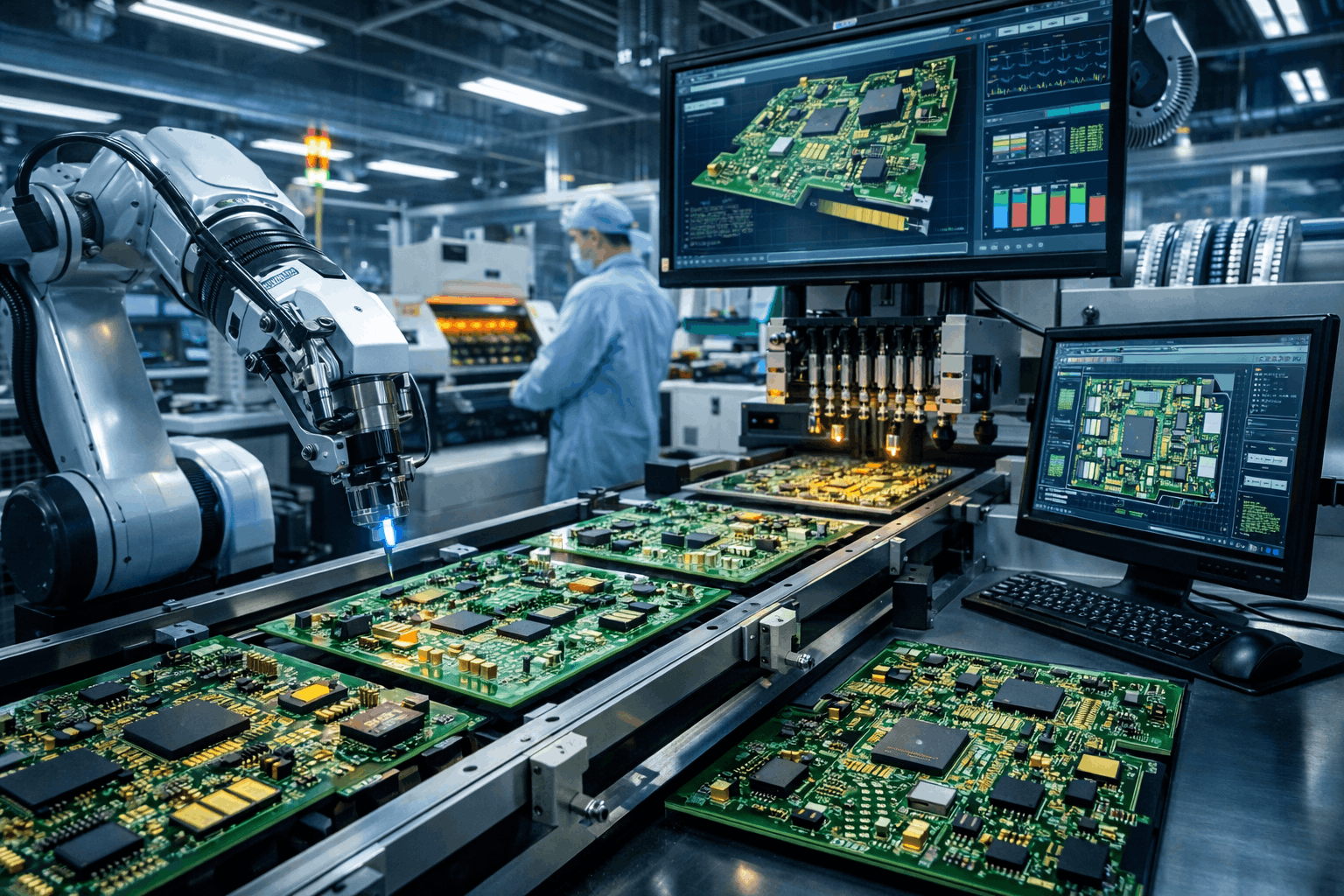
Industry 4.0 | Robotics | Digital Twin | IIoT | Regional Breakdown | March 2026 | Source: Wise Guy Reports
| $658.4B
Market Value by 2032 |
14.8%
CAGR (2024–2032) |
$240.6B
Market Value in 2024 |
Overview
Smart Manufacturing Market global Smart Manufacturing Market is projected to grow from USD 240.6 billion in 2024 to USD 658.4 billion by 2032, registering a 14.8% CAGR. The integration of Industrial IoT sensor networks, AI-powered analytics, collaborative robotics, digital twin simulation, and advanced automation technologies across discrete and process manufacturing is redefining factory operations from labour-intensive, reactive production environments to predictive, autonomous, and data-intelligent manufacturing ecosystems — with Industry 4.0 adoption now an existential competitive imperative for manufacturers facing labour cost pressures, supply chain resilience requirements, and sustainability compliance mandates.
Key Takeaways
- The Smart Manufacturing Market is projected to reach USD 658.4 billion by 2032 at a 14.8% CAGR.
- Industrial IoT deployments generating real-time sensor data from 29 billion connected devices by 2030 are the primary smart manufacturing investment catalyst.
- AI-driven predictive maintenance reduces unplanned downtime by 45% and overall equipment effectiveness (OEE) improves by 12–18 percentage points.
- Collaborative robots (cobots) are growing at 24% CAGR, with deployment costs declining 52% since 2018 making automation accessible to SMB manufacturers.
- Digital twin adoption in automotive and aerospace manufacturing improves production yield by 14–22% and new product introduction timelines by 31%.
Segment & Technology Breakdown
| Technology / Segment | Primary Buyer | Key Driver | Outlook |
| Industrial IoT & Sensor Networks | All Verticals | Real-time operational data, asset tracking | Foundational; 29B devices by 2030 |
| AI Analytics & MES Platforms | Automotive, Electronics, Pharma | OEE, quality, energy optimisation | Dominant; 17% CAGR segment |
| Collaborative Robots (Cobots) | SMB, Automotive, Electronics | Flexible automation, labour supplement | Fast-growing; 24% CAGR |
| Digital Twin & Simulation | Aerospace, Automotive | Virtual production optimisation, NPI | High-growth; 22% yield improvement |
| Additive Manufacturing / 3D Print | Aerospace, Medical, Tooling | On-demand parts, rapid prototyping | Strong; supply chain resilience |
What Is Driving Demand?
Industrial IoT & Real-Time Operational Intelligence
The deployment of 29 billion Industrial IoT sensors across production lines, assets, and logistics networks is generating petabyte-scale operational data that purpose-built manufacturing analytics platforms convert into real-time OEE dashboards, predictive failure alerts, quality deviation signals, and energy consumption optimisation recommendations — delivering 18-point OEE improvements and USD 4.8 million average annual operational savings per 500-employee facility within 12 months of platform commissioning.
AI-Powered Predictive Maintenance
Machine learning models analysing vibration, temperature, acoustic, and current draw sensor data from rotating equipment are predicting failure events 14–21 days in advance with 91% accuracy — enabling condition-based maintenance that reduces unplanned downtime by 45%, extends asset useful life by 20–28%, and reduces spare parts inventory costs by 18% versus calendar-based preventive maintenance programmes. Predictive maintenance represents the single highest ROI use case in smart manufacturing deployment.
Collaborative Robotics & Flexible Automation
The declining cost of collaborative robots (USD 28,000–65,000 per unit in 2025 versus USD 58,000–120,000 in 2018) combined with no-code programming interfaces is democratising automation beyond Tier 1 automotive and electronics manufacturers into SMB food processing, pharmaceuticals, and logistics operations. Cobot deployments deliver average payback periods of 14–18 months, 52% reduction in ergonomic injury incidents, and 34% throughput improvement on repetitive assembly tasks — without safety cage requirements that traditionally added USD 40,000+ to robot deployment budgets.
Digital Twin & Virtual Factory Optimisation
Physics-based digital twins of production lines and entire factory layouts are enabling virtual production scenario testing — optimising throughput configurations, tooling parameters, and maintenance scheduling without production line stoppages. NVIDIA Omniverse, Siemens Xcelerator, and PTC ThingWorx digital twin implementations report 14–22% production yield improvement and 31% faster new product introduction (NPI) timelines versus conventional trial-and-error process development in automotive and aerospace deployments.
Supply Chain Resilience & Nearshoring
Post-COVID supply chain disruption and geopolitical decoupling are driving reshoring and nearshoring of manufacturing operations to North America, Europe, and domestically within Asia-Pacific — with greenfield smart factory investments in nearshore locations prioritising smart manufacturing technology from day one rather than retrofitting legacy infrastructure. The USD 220+ billion CHIPS and Science Act (US), EU Chips Act, and India PLI manufacturing incentives are funding smart semiconductor and electronics manufacturing investments requiring Industry 4.0 capability as programme qualification criteria.
| Get the full data — free sample available:
→ Download Free Sample PDF | Includes market sizing, segmentation methodology & regional forecast tables. |
| KEY INSIGHT: Manufacturers achieving full Industry 4.0 technology stack integration — IIoT sensor networks, AI analytics, collaborative robotics, digital twin, and energy management — report 42% reduction in total manufacturing cost per unit, 28% improvement in OEE, 34% decrease in quality defect rates, and 18% reduction in carbon emissions per unit produced — delivering an aggregate financial benefit of USD 12.4 million annually per 1,000-employee manufacturing facility versus traditional automation-only deployments. |
Regional Market Breakdown
| Region | Maturity | Key Drivers | Outlook |
| Asia-Pacific | Dominant | China Made in China 2025, Japan robotics, South Korea smart semiconductor | Highest volume; greenfield smart factories |
| North America | Mature + Accelerating | CHIPS Act investment, nearshoring, automotive EV smart factories | Strong; reshoring + EV manufacturing |
| Europe | Leader (Policy) | Industry 4.0 originator, DACH machinery, EU CBAM energy compliance | Strong; sustainability + automation |
| Latin America | Emerging | Mexico nearshoring, Brazil automotive, food & beverage automation | Growing; nearshoring investment catalyst |
| MEA | Expanding | Saudi NEOM manufacturing, UAE advanced industry, Africa resource automation | Accelerating; sovereign manufacturing goals |
Competitive Landscape
Key vendors include Siemens (Xcelerator/MindSphere), Honeywell (Forge), PTC (ThingWorx), GE Digital (Predix), Rockwell Automation (FactoryTalk), ABB (Ability), FANUC, Yaskawa (cobots), Universal Robots (Teradyne), KUKA, Palantir AIP, and AVEVA. IIoT integration breadth, AI analytics depth, digital twin fidelity, cobot ecosystem, and energy management capability are primary competitive differentiators.
Outlook Through 2032
The Smart Manufacturing Market through 2032 will be defined by AI-native manufacturing operating systems replacing legacy SCADA and MES platforms, digital twin simulation becoming standard for every major production investment decision, autonomous mobile robots (AMRs) and cobots achieving majority adoption across mid-market manufacturers, and sustainability analytics evolving from reporting to real-time carbon optimisation. Technology vendors delivering integrated IIoT-to-cloud manufacturing intelligence platforms with proven OEE, quality, and carbon ROI will dominate enterprise procurement as smart manufacturing transitions from competitive differentiator to baseline operational standard.
Source: Wise Guy Reports (WGR) | All market projections are forward-looking estimates and subject to revision. © WGR · wiseguyreports.com